Wildcard Queries#
The asf-search module and SearchAPI support querying scene names via wildcards ("*" for matching any number of characters and "?" for a single character) with the granule_list keyword and is also available on dataset search type in Vertex. This enables searching metadata embedded in scene names. Below are examples of useful queries with certain datasets.
Using Wildcards#
Below are some basic examples of searching for Sentinel-1D SLCs and/or NISAR PR RSLC using only wildcards.
asf-search python module#
In asf-search, wildcard queries are available with the existing granule_list keyword.
import asf_search as asf

response = asf.search(
    granule_list=['NISAR_L1_PR_RSLC*', 'S1D_IW_SLC*'],
    maxResults=250
)

response.geojson()
SearchAPI#
Like asf-search, SearchAPI accepts wildcard queries with the granule_list keyword.
https://api.daac.asf.alaska.edu/services/search/param?granule_list=NISAR_L1_PR_RSLC*,S1D_IW_SLC*&maxResults=250&output=geojson
Note: maxResults is required when using SearchAPI. For unbounded results, use asf-search.
Vertex#
Wildcards are supported in the Scene Name Patterns field using Geographic Search, accessible via the filters panel.
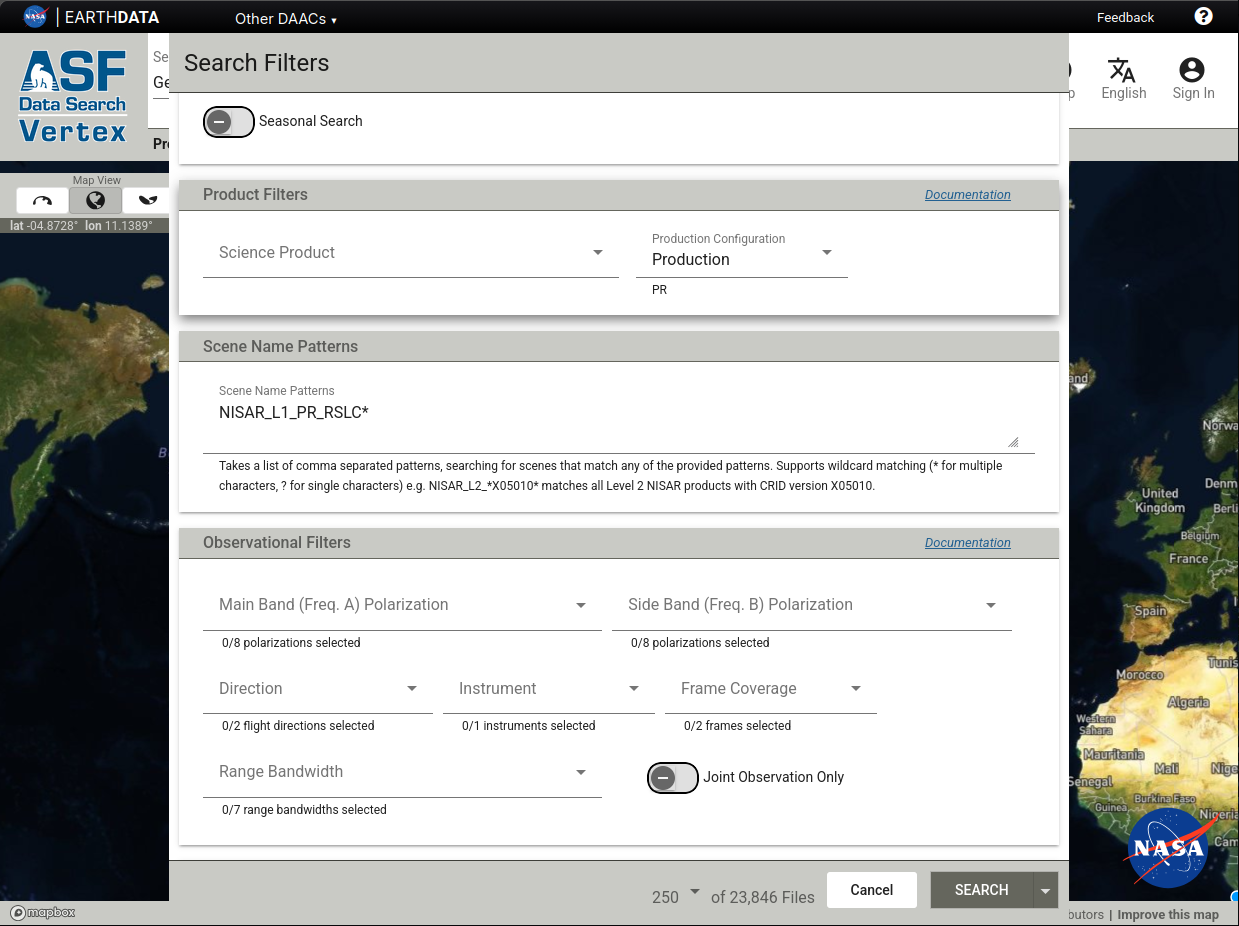
Note: cross-dataset results are not supported in Vertex.
NISAR#
NISAR data product names contain a few pieces of metadata that aren't directly searchable by additional attributes in CMR or aren't searchable params in asf-search.
For a breakdown of NISAR data product naming conventions see ASF's NISAR user manual.
CRID Version Number#
The asf-search python module, SearchAPI, and Vertex don't explicitly provide a search parameter for CRID versions, but wildcards offer a way to do search for them.
- match all Level 2 NISAR products with CRID version X05010:
NISAR_L2_*X05010*
- match all NISAR science products with CRID version X05010 and above:
NISAR_L?_*X0501?*
- match all NISAR products with CRID version P05012 and above:
NISAR_*P05012*
Freq A & B Polarizations#
While asf-search provides searching on these mainBandPolarization and sideBandPolarization fields, you can't search exclusively on single band data without possibly getting both bands in results. Data products denote when a band isn't used with NA.
- Data products that strictly contain frequency A HH data:
NISAR_L?_\*_SHNA\*
Cycles#
Cycles are represented by 3 characters near the beginning of the granule name, each increment indicating which 12 day repeat pass the scene was taken during. In the case of NISAR_L2_PR_GUNW_003_136_D_081_008_4000_SH_20251026T153228_20251026T153231_20251225T153231_20251225T153234_X05010_N_P_J_001
the 003 indicates this scene was taken during 3rd cycle.
-
For all products that were taken during the 3rd cycle:
NISAR_L?_PR_????_003_*
-
For all products that were taken during cycles 1-9:
NISAR_L?_PR_????_00*
-
For all products that were taken during cycles 9 and 10:
NISAR_L?_PR_????_009*,NISAR_L?_PR_????_010*
Stack IDs#
Stack IDs are useful for building timeseries and are formatted as RelativeOrbit_OrbitDirection_FrameNumber.
Example stack ID wildcard:
NISAR_\*165_D_100\*- Relative Orbit: 165
- Orbit Direction: D (Descending)
- Frame Number: 100
Here is how to use the above pattern with the asf-search python module to get adjacent NISAR timeseries results.
import asf_search as asf

# Two adjacent stacks
stack_ids = ['165_D_100', '165_D_101']

multi_stack_results = asf.search(
    dataset=asf.DATASET.NISAR,
    granule_list=[f'NISAR_*{stack_id}*' for stack_id in stack_ids]
    )

multi_stack_results.geojson()
OPERA-S1#
OPERA-S1 has a few useful fields not directly covered in places like Vertex but are possible in SearchAPI and asf-search.
Search for Level 2 OPERA products that use S1C as source acquisitions:
OPERA_L2_*S1C_*
Vertex doesn't directly support searching on track number for OPERA-S1 data but users can use a pattern like OPERA_L*-S1_T<Track ###>* to limit to a specific track number.
The below pattern would return OPERA-S1 level 2 products with track number 95:
OPERA_L2_*-S1_T095*
OPERA Project spec pages are available here.